









 Assistant
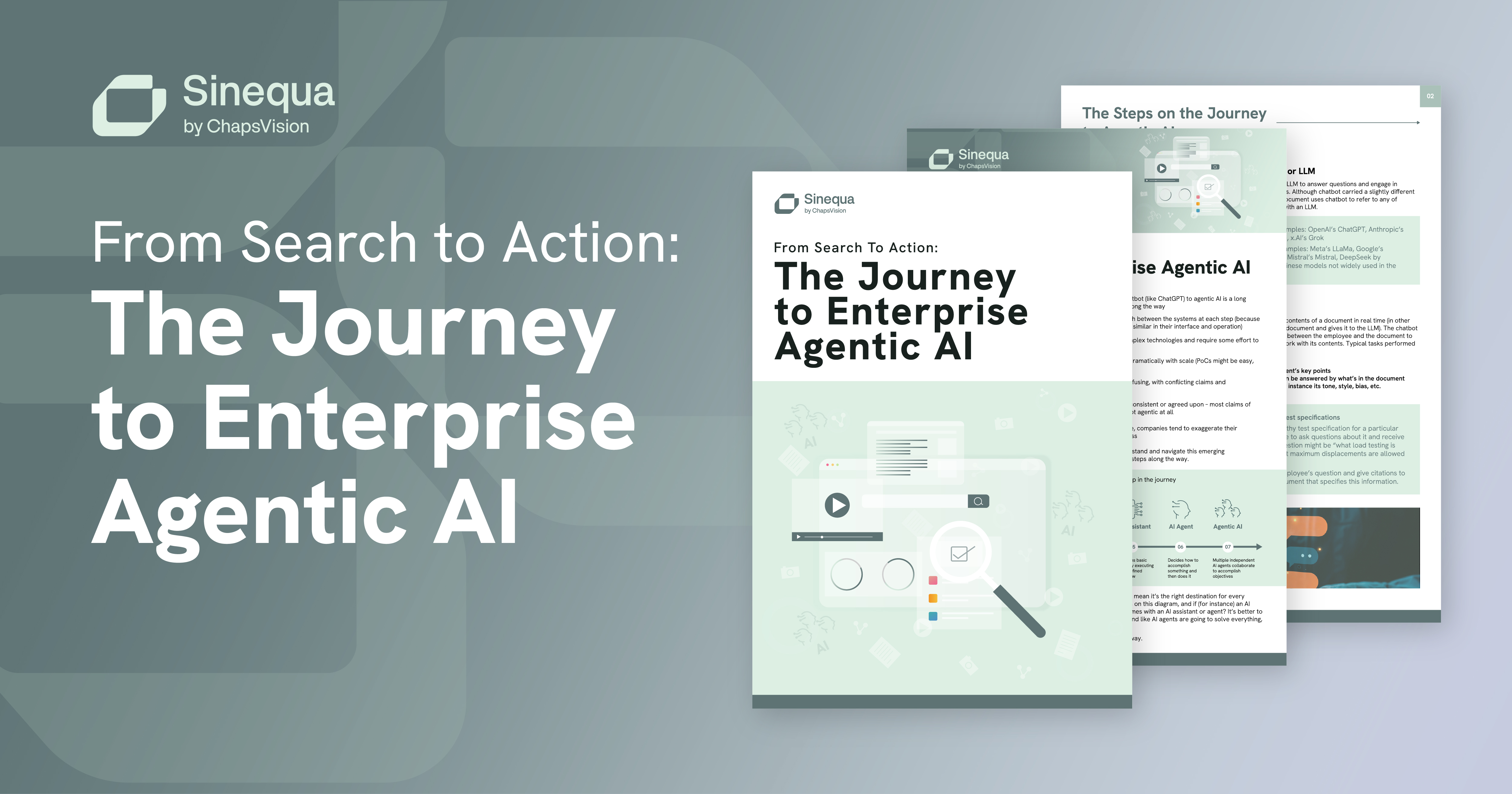
From Search to Action: The Real Journey to Enterprise Agentic AI
Download the Whitepaper

What’s Inside
- The 7-Stage Agentic AI Maturity Model: A structured progression from basic document retrieval to fully autonomous agentic ecosystems with the specific architectural requirements, data readiness criteria, and governance conditions that define each stage. The model gives enterprise leaders a precise answer to the question every organization is currently asking: where are we, and what does the next stage actually require? The seven stages span the full journey from keyword search through RAG-grounded AI assistants to multi-agent autonomous workflows — with each transition point defined by what breaks if you skip it.
- The “Expert” Spectrum: Document Experts vs. Autonomous Agents: Not all AI agents are the same. The whitepaper defines the spectrum from document experts (AI that retrieves, synthesizes, and explains from governed enterprise content) to autonomous agents (AI that plans, decides, and acts across multi-step workflows without human initiation). Understanding where on this spectrum a use case belongs — and deploying accordingly — is what separates successful production deployments from stalled POCs.
- The Architecture Gap at Each Stage: How RAG architecture, workflow orchestration, tool integration, and access control requirements evolve as you move up the maturity curve. The architecture that works at Stage 2 is not the architecture that works at Stage 5. Organizations that try to shortcut this progression encounter exactly the failures that give enterprise AI a bad reputation: hallucinations, access control failures, workflows that degrade at edge cases, and agents that cannot be audited when something goes wrong.
- Strategic Sequencing: Which Use Cases to Solve First: Why some enterprise use cases are better solved at lower maturity stages and why pushing prematurely toward full autonomy on the wrong use cases creates risk without reward. The whitepaper provides the decision framework for sequencing agentic AI investments in order of readiness, value, and governance tractability.
Who Should Read This
For enterprise leaders actively navigating the move from AI experimentation to AI operations — specifically:
- CIOs and CTOs setting the enterprise AI platform architecture and needing a framework to evaluate where the organization sits and what the path forward requires
- AI architects and platform engineers designing agent orchestration layers and needing a stage-by-stage technical specification of what changes as autonomy increases
- Heads of Digital Transformation responsible for sequencing AI investments and explaining to leadership why some capabilities require foundational work before full autonomy is achievable
- Innovation and automation leaders who have working POCs and need a framework to diagnose why they are not scaling to production
Frequently Asked Questions (FAQ)
The 7-Stage Maturity Model maps the full progression from basic document retrieval and keyword search through RAG-grounded AI assistants to fully autonomous multi-agent AI ecosystems. Each stage is defined by specific architectural requirements — covering RAG design, workflow orchestration, tool integration, and access control — as well as the data readiness and governance conditions that must be in place before advancing. The model gives enterprise leaders a precise, actionable framework for assessing their current position and understanding exactly what the next stage requires, rather than treating agentic AI as a binary “deployed or not deployed” decision.
The chatbot stage (typically Stage 2 or 3 in the maturity model) works reasonably well under controlled conditions: a narrow set of documents, a predictable query type, a constrained user population. What causes stalling is the gap between that controlled environment and the reality of enterprise deployment — where documents span dozens of systems and formats, queries are unpredictable, users have different access rights, and workflows must handle edge cases reliably. Moving beyond this stage requires architectural changes to the retrieval layer (moving from naive to sophisticated RAG), governance structures for access control at scale, and workflow orchestration that handles failure gracefully. Without a maturity framework, organizations either over-invest in capabilities their data readiness doesn’t support yet, or under-invest in the foundational work that would make advancement possible.
A document expert is an AI system that retrieves, synthesizes, and explains information from governed enterprise content — answering questions, surfacing relevant knowledge, and generating cited responses grounded in actual enterprise data. It operates reactively: it responds when asked. An autonomous agent additionally plans, decides, and acts — monitoring environments, initiating multi-step workflows, taking actions in connected systems, and completing tasks without requiring a human to initiate each step. The whitepaper defines the full spectrum between these poles and the architectural and governance requirements that distinguish each point on the spectrum from the next.
At early maturity stages, RAG (Retrieval-Augmented Generation) operates as a relatively simple retrieval-then-generation pipeline: retrieve relevant documents, pass them to an LLM, generate a response. As maturity increases, RAG architecture must evolve significantly: multi-step retrieval for complex queries that require synthesizing information from multiple sources, tool-augmented retrieval that combines document retrieval with structured data queries and API calls, access-controlled retrieval that enforces source system permissions at every step and across every agent in a multi-agent workflow, and iterative retrieval where agents reformulate queries based on intermediate results. The whitepaper maps exactly how RAG architecture must evolve at each stage transition and what breaks if the evolution is skipped.
The maturity framework is most immediately applicable to the industries where enterprise AI agents are being deployed on the highest-stakes knowledge workflows: life sciences (clinical research, regulatory submissions, pharmacovigilance), manufacturing (engineering knowledge retrieval, maintenance operations, product life cycle management), financial services (compliance intelligence, regulatory research, risk analysis), energy (operational knowledge management, maintenance support, safety documentation), and aerospace and defense (program knowledge, classified workflow support, multi-domain engineering). These are the environments where Sinequa’s maturity framework was developed and stress-tested in production — and where the cost of getting the architecture wrong is highest.
Share


