





Trustworthy Agentic AI: Building Agentic Systems for the Enterprise
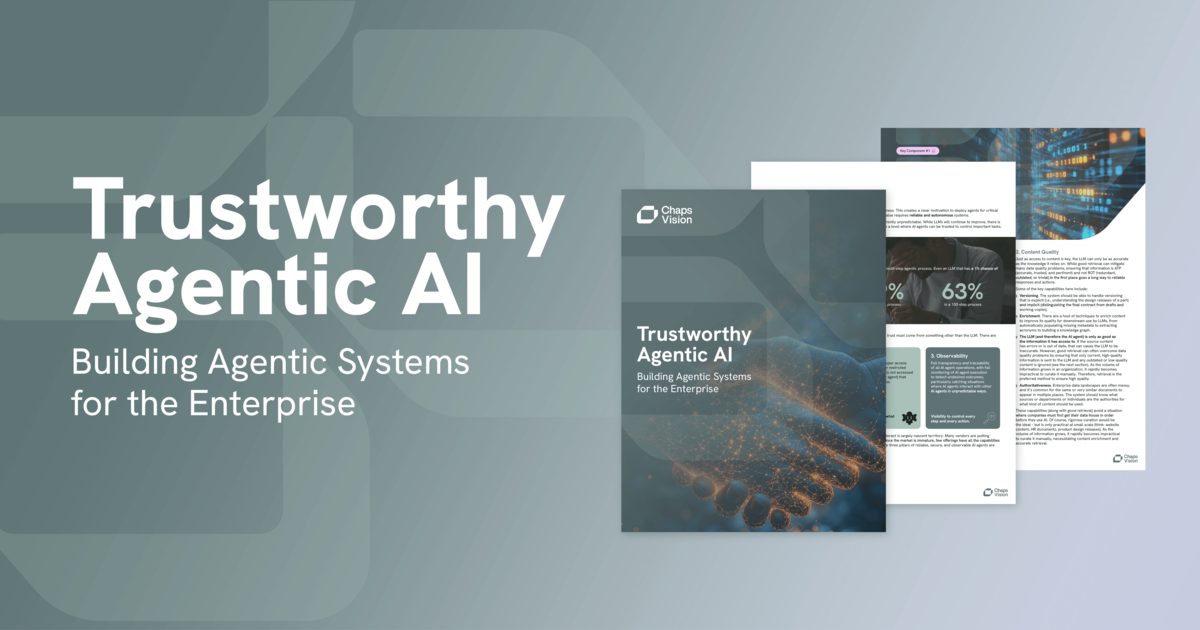
Reliable. Secure. Observable.
Transform your AI agents from experiments into enterprise-grade tools.
Generative AI is transforming business, but “good enough” isn’t enough for critical workflows. Most AI agents struggle with accuracy, security, and transparency, creating risk in high-stakes decisions.
In multi-step agentic workflows, even a tiny 1% error per step can escalate to a 63% total error rate over 100 steps. Without a strategy for reliability, security, and observability, AI agents can introduce more risk than value.
What You’ll Learn in Our Whitepaper
Get a technical framework and strategic roadmap to deploy AI agents that are reliable, secure, and transparent, giving your organization the confidence to scale AI safely.
- Reliability: Architect AI agents that self-correct, recognize limits, and handle out-of-scope tasks.
- Security: Enforce strict, “Closed-by-Default” access policies and secure RAG/LLM integration.
- Observability: Gain full workflow tracing, real-time metrics, and actionable insights to monitor agent performance.
- Governance: Control costs, enforce compliance, and manage operational risk at scale.
Who Should Read This Whitepaper
For enterprise leaders moving agentic AI from proof-of-concept to production — specifically:
- CIOs and CTOs accountable for AI platform strategy and for what happens when agents make wrong decisions on critical processes
- AI architects designing agent orchestration layers who need a concrete framework for trustworthiness by design
- Chief Compliance, Risk, and Data Governance Officers who need to understand what governance architecture agentic AI requires before it reaches regulated workflows
- Heads of Digital Transformation under pressure to deliver AI outcomes that are both impactful and defensible
What these roles share: they need agentic AI to be trustworthy — not as a marketing claim, but as an architectural property that can be demonstrated, monitored, and maintained in production
Frequently Asked Questions (FAQ)
Trustworthy agentic AI refers to AI agent systems that are architecturally designed to be reliable, secure, observable, and governed — not as aspirational properties, but as verifiable, maintainable characteristics of the deployed system. For single-turn AI interactions (a user asks a question, an AI responds), trustworthiness matters but errors are bounded. For multi-step agentic workflows — where an AI agent autonomously retrieves information, makes decisions, and takes actions across a sequence of steps — errors compound mathematically. A 1% error rate per step produces a 63% total error rate over 100 steps. In enterprise environments where agents operate on mission-critical workflows, regulated content, or safety-sensitive processes, this compounding risk profile makes trustworthiness architecture a deployment prerequisite, not a nice-to-have.
The framework in the whitepaper defines four architectural pillars. Reliability covers the design patterns that enable AI agents to self-correct, recognize the limits of their knowledge or context, and escalate to human review rather than producing confident incorrect outputs at the edges of their capability. Security covers the Closed-by-Default access architecture that ensures AI agents enforce source system permissions at every retrieval step — preventing access control failures in RAG pipelines and LLM integrations. Observability covers the end-to-end workflow tracing, real-time metrics, and monitoring infrastructure that gives operations teams full visibility into agent behavior in production. Governance covers the cost controls, compliance enforcement mechanisms, and operational risk management frameworks that bring agentic AI under enterprise-standard governance at scale.
The whitepaper is most relevant to four enterprise roles. CIOs and CTOs accountable for AI platform strategy and for what happens when AI systems make wrong decisions on critical processes. AI architects and enterprise AI platform teams designing agent orchestration layers and the technical architecture that determines how trustworthy agents behave at the edge cases. Chief Compliance Officers, Chief Risk Officers, and Heads of Data Governance who need to understand what governance architecture agentic AI requires before it reaches regulated workflows. Heads of Digital Transformation who need to move agentic AI from proofs-of-concept to production deployments that can withstand organizational scrutiny and audit review.
Sinequa’s Enterprise Agentic AI Platform implements the four-pillar trustworthiness architecture described in the whitepaper as native platform capabilities. Reliability is addressed through retrieval grounding — AI agents generate answers from retrieved, cited enterprise content rather than from LLM training data, eliminating the hallucination risk that characterizes ungrounded deployments. Security is addressed through document-level access control inheritance — agents enforce the same access permissions as the source systems they retrieve from, enforced at every retrieval step. Observability is built into the platform’s workflow tracing and metrics infrastructure. Governance is addressed through cost controls, audit trail generation, and compliance enforcement that apply consistently across agent instances.
Assistant
