









 Assistant
From Search to Strategy: How AI Agents Are Reshaping Legal Work
Purpose-Built Legal AI Agents That Work Across Your Document Management Systems
With the Confidentiality and Governance Your Firm Requires
Legal professionals do not have a shortage of information. They have a retrieval and synthesis problem: critical precedents buried across matter files in iManage, contract terms scattered across NetDocuments repositories, regulatory guidance spread across SharePoint libraries and external sources — none of it searchable together, none of it available to an AI system that understands legal context and enforces client confidentiality at the access layer.
Generic AI tools make this problem worse before they make it better. A general-purpose LLM that cannot enforce matter-level confidentiality, cannot distinguish privileged from non-privileged material, and cannot ground its outputs in the firm’s actual document environment is not a legal tool. It is a liability.
Sinequa for Legal is designed from the ground up for the requirements of enterprise legal environments: AI agents that retrieve, synthesize, draft, and act on legal knowledge grounded in the firm’s own governed document repositories with client confidentiality, matter-level access controls, and full audit trails built into the architecture, not bolted on afterward.
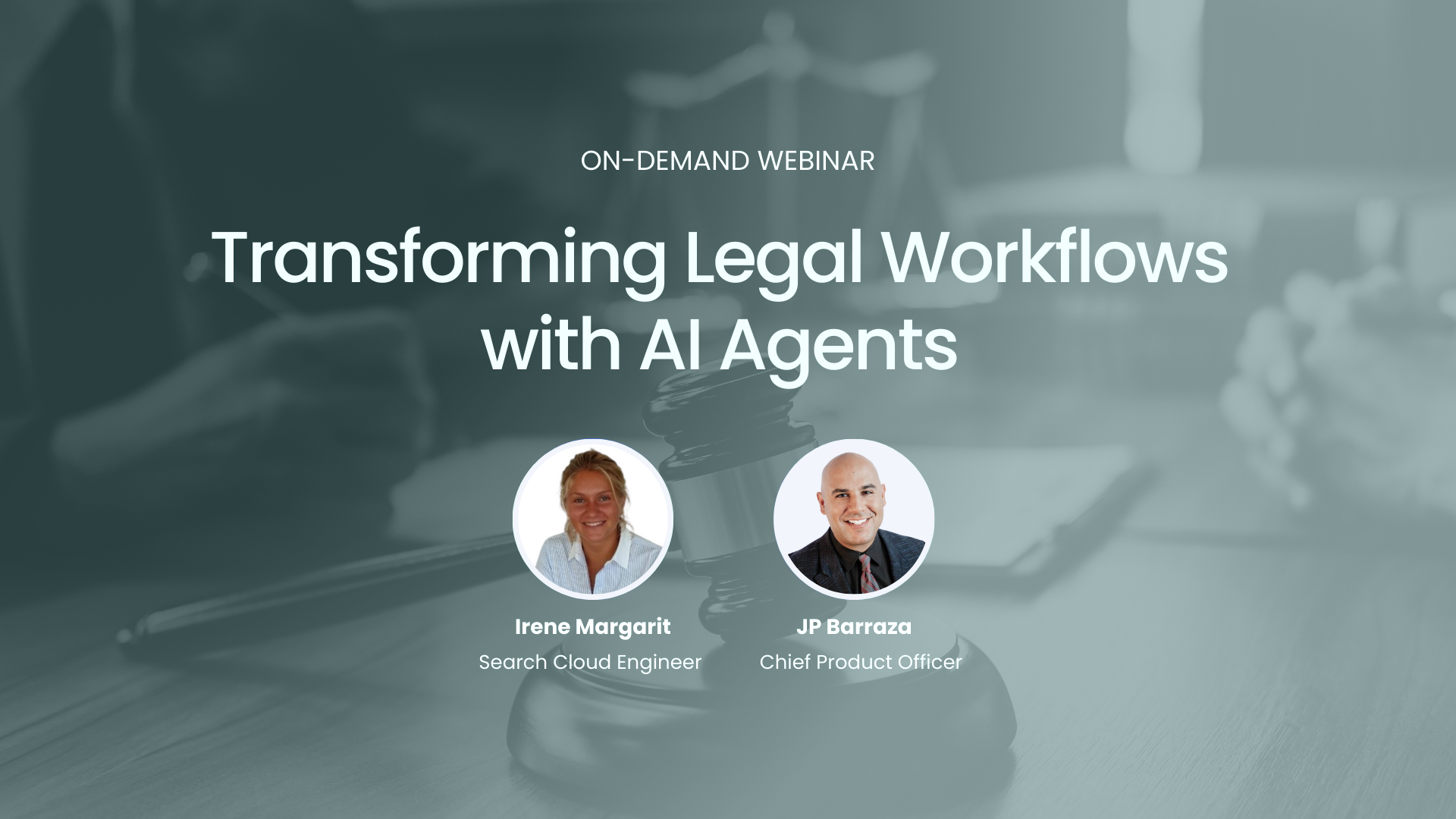
This on-demand webinar shows exactly how it works, and what leading legal teams are doing with it today.
Watch the on-demand webinar

What the Webinar Covers
Legal AI Agents That Act on Governed Knowledge — Not Generic Training Data
The distinction between a legal AI agent and a general-purpose chatbot is architectural: a legal AI agent retrieves from the firm’s actual matter files, precedent libraries, contract repositories, and regulatory databases — with every output cited, traceable to source documents, and generated only from information the requesting user is authorized to access. The webinar demonstrates how Sinequa’s AI agents operate within this governed framework across iManage, NetDocuments, SharePoint, and the firm’s other document management systems.
Accelerating the Highest-Value Legal Workflows
The webinar walks through production use cases across four workflow categories where Legal AI Agents are delivering measurable time savings for enterprise legal teams:
- Contract review and analysis: AI agents that surface key terms, flag non-standard clauses, identify missing provisions, and compare against playbook standards — across hundreds of contracts simultaneously, not sequentially
- Matter research and precedent retrieval: Unified search across the full matter file history with AI-synthesized summaries, so associates and partners find relevant precedents in minutes rather than hours of document review
- Regulatory monitoring and change tracking: Continuous AI-assisted monitoring of regulatory developments across relevant jurisdictions, with structured alerts and impact assessments aligned to the firm’s practice areas
- Litigation support and privilege review: AI-assisted document classification, privilege tagging, and relevance review that compresses review timelines without compromising the attorney judgment that privilege determinations require
Multilingual Legal Intelligence Across 55+ Languages
For global law firms and in-house legal teams at multinationals, legal work does not stop at language boundaries. Cross-border transactions, international regulatory compliance, and multi-jurisdiction litigation all require working with documents in languages other than the team’s primary working language. Sinequa’s integration with SYSTRAN’s domain-specific legal translation models — supporting 55+ languages with terminology precision calibrated for legal documents — means AI agents can retrieve, synthesize, and work with multilingual matter files without manual translation as a bottleneck. Documents are translated at indexing time, so search and AI synthesis work across language boundaries transparently.
Data Sovereignty, Confidentiality, and Governance
Legal AI cannot be deployed on client data without clear answers to the governance questions clients are increasingly asking: where does the data go, who can access it, can AI outputs be audited, and how are matter-level confidentiality obligations enforced? The webinar addresses each of these directly — covering Sinequa’s deployment architecture for on-premise, private cloud, and hybrid environments; the access control model that enforces matter and client confidentiality at the retrieval layer; and the audit trail capabilities that compliance and risk functions require.
Who Should Watch
- General Counsel and Chief Legal Officers evaluating enterprise AI strategy for in-house legal departments and needing a framework for responsible AI adoption on client and corporate matters
- Legal Operations and Technology Directors selecting and deploying legal AI platforms and needing a concrete demonstration of what purpose-built legal AI delivers versus generic tools
- Law firm Managing Partners and Innovation leads assessing AI capability gaps and competitive positioning as client expectations for AI-assisted legal services increase
- Senior Associates and Practice Group Leaders who want to understand what Legal AI Agents actually do in a document management environment they already use
Frequently Asked Question
Sinequa for Legal is a purpose-built enterprise AI platform for legal work that combines AI-powered search, advanced RAG (Retrieval-Augmented Generation), and AI agents specifically configured for legal document environments. The core architectural difference from general-purpose legal AI tools is where the knowledge comes from: Sinequa for Legal retrieves and synthesizes from the firm’s own governed document repositories — iManage, NetDocuments, SharePoint, and other DMS platforms — with access permissions enforced at the retrieval layer. This means AI outputs are grounded in the firm’s actual matter files and precedents, with client confidentiality and matter-level access controls maintained throughout. General-purpose tools that operate on public legal databases or training data cannot provide this combination of proprietary knowledge access and governance.
Sinequa for Legal connects to the document management systems enterprise legal teams actually use, including iManage, NetDocuments, SharePoint, and other legal DMS platforms, as well as broader enterprise systems that contain legally relevant content — contract management platforms, CRM systems, compliance repositories, regulatory databases, and email archives. Integration is handled without requiring data migration: Sinequa’s AI layer indexes and retrieves from documents where they already live, maintaining existing DMS governance controls and matter structure. This approach means the firm does not need to consolidate or move client-sensitive documents to a third-party environment to benefit from AI-powered search and synthesis.
Sinequa integrates with SYSTRAN’s domain-specific translation models, which are calibrated for legal terminology precision across 55+ languages. Unlike general machine translation that renders legal language in generic terms, SYSTRAN’s legal domain models preserve the terminology distinctions that matter in legal documents — the difference between representations and warranties, conditions precedent, and indemnification obligations does not survive translation that treats legal language as general text. In Sinequa for Legal, translation occurs at document indexing time, meaning legal documents in any supported language are made searchable and available to AI synthesis alongside English-language materials without manual translation workflows. This is particularly valuable for cross-border transaction teams, multi-jurisdiction regulatory matters, and global in-house legal departments managing compliance obligations across multiple legal systems.
Share


