











 Assistant
KMWorld 2025 Recap: Enterprise Agentic AI at Scale: A Case Study
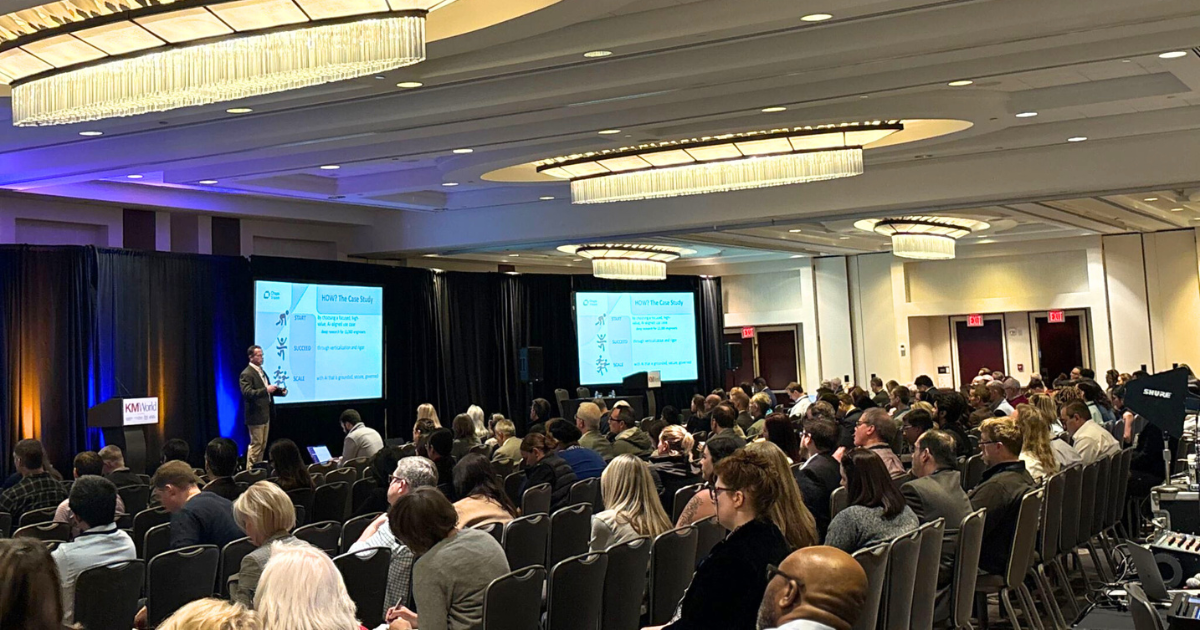
At KMWorld 2025, one theme cut through every keynote, panel, and hallway conversation: enterprises are urgently trying to turn AI prototypes into real, scalable value. Curiosity is high, but mature execution is rare. Many organizations remain stuck in the proof-of-concept (POC) stage, unsure how to move safely, efficiently, and with measurable ROI.
That’s why Jeff Evernham, Chief Product Officer, Sinequa at ChapsVision, delivered one of the conference’s most actionable sessions: “Enterprise Agentic AI at Scale: A Case Study”
In just 15 minutes, Jeff broke down what it truly takes to deploy AI agents across a complex global enterprise, and the practical lessons every knowledge-driven organization can apply today. He showed that success requires investing in a secure, RAG-ready retrieval platform like Sinequa that delivers the context, trust, and measurable business impact required for enterprise scale.
Why Agentic AI Is Reshaping Knowledge Management
Jeff started by grounding the audience in a technical reality: AI Agents are only as intelligent as the data they can access.
Traditional enterprise search links. Simple chatbots generate text. But Agentic AI must reason, interpret contextual signals, and take purposeful actions.
To frame the shift underway, Jeff outlined the growing evolution of enterprise agents and why organizations moving beyond the “agent-adjacent” stage need more than just a Large Language Model, they need deep, structured access to enterprise knowledge.
As McKinsey reports from their “The state of AI in 2025: Agents, innovation, and transformation“ survey that one in four global enterprises is already deploying agentic AI at scale, and these adopters are opening a measurable performance gap.
The Reality Check: Most AI Pilots Fail to Scale (It’s a Data Problem)
Despite massive investment, 95% of enterprise AI pilots never make it to production. Jeff pinpointed the core technical failure: The disconnect between the LLM and enterprise knowledge.
Without a robust Retrieval-Augmented Generation (RAG) framework, agents face:
- Hallucinations: Guessing answers because they lack source data.
- Security Gaps: Accessing documents the user shouldn’t see.
- Lack of Grounding: Providing generic answers rather than domain-specific ones.
As Jeff quoted analyst Alan Pelz-Sharpe: “AI agents work—often really, really badly.”
Enterprises need systems that are accurate, explainable, governed, and aligned with real tasks, not demos that work only under ideal conditions.
Inside a Real Deployment: Agentic AI in Engineering & R&D
The centerpiece of Jeff’s keynote was a detailed case study from a global engineering and manufacturing leader. He walked through a real transformation showing how the organization moved from scattered AI experiments to agentic systems using a retrieval-first architecture that now supports critical engineering and R&D workflows.
Jeff unpacked:
- The challenge that triggered their first Agentic AI initiative
- How they selected the right workflow to start
- The early breakthroughs that unlocked enterprise-wide momentum
The full story reveals the turning points and decisions that made enterprise-scale adoption possible.
Get the full journey and outcomes
Watch the keynote replayHow Enterprises Can Replicate This Success
Jeff closed with a framework for organizations ready to move beyond AI pilots, focusing on the workflow, the retrieval foundation, and the governance required for scale.
He emphasized one clear message: Organizations that build on a proven retrieval platform are significantly more likely to scale Agentic AI successfully.
Key Takeaways
- ROI is Real: Agentic AI is already delivering real enterprise ROI, not just theoretical promise.
- Core requirements: Context, accuracy, and governance matter more than ever.
- Path to Success: Focused, high-value use cases are the fastest path to measurable wins.
- Immediate benefits: Engineering, R&D, and compliance functions are seeing immediate benefits.
- Future performance: Enterprises that invest now will widen the performance gap for years to come.
Conclusion
KMWorld 2025 made it clear: the enterprise AI landscape is shifting from experimentation to execution. The organizations that succeed will be the ones that treat Agentic AI not as a novelty, but as a strategic capability, anchored in context, trust, and measurable business impact.
As Jeff demonstrated, scaling AI agents inside a complex enterprise isn’t just possible; it’s happening today in engineering, R&D, and other knowledge-intensive functions. And for companies ready to move beyond pilots, the path forward is clearer than ever: start with focused, high-value use cases, validate rigorously, and build on a foundation of secure, explainable, well-governed AI.
At Sinequa by ChapsVision, this has been our mission for over two decades: to help the world’s most data-rich organizations operationalize their knowledge, accelerate discovery, and deploy intelligent systems that truly understand work. With the rise of Agentic AI, that mission has never been more important or more achievable.
Enterprises that invest now aren’t just modernizing their knowledge of ecosystem; they’re shaping the next era of enterprise performance.
Want to learn more about our solutions?
Get in touch with our teamShare