









 Assistant
Beyond Chatbots and Copilots: The Rise of Operational AI in the Enterprise
In boardrooms and engineering labs across the globe, enterprise leaders are confronting a stark reality: despite massive investments in artificial intelligence, the most consequential decisions in business are still made without it.
Whether designing life-saving pharmaceuticals, engineering commercial aircraft, managing energy grids, or navigating complex defense regulations, these environments operate where being wrong isn’t just an inconvenience; it’s not an option. The hard truth is that the first wave of enterprise AI was never designed to handle this level of complexity.
To understand why current tools stall out when stakes are high, we must examine the three distinct categories of enterprise AI systems, and see why moving from working on productivity tasks to working on the differentiated, operational work that adds value to your business requires a fundamental architectural shift.
The 3 Categories of Enterprise AI Systems
Not all AI is built for the same job. To evaluate where AI creates value—and where it poses risk—it helps to categorize tools by their underlying context, governance, and capacity for mission-critical execution.
1. Generic AI: Chatbots with World Knowledge
Generic AI models are designed for broad utility. Powered by massive public datasets, these tools excel at creative brainstorming, draft writing, and general knowledge synthesis.
- Right for: General, non-sensitive tasks.
- Context: Public world knowledge; zero proprietary business context.
- Stakes: Low. Answers are disposable, and outputs require human verification.
- Rules & Ownership: Severely limited output and data controls. Hosted in vendor clouds with model lock-in.
- Representative Examples: ChatGPT, Gemini.
2. Productivity AI: Embedded in Office Tools
Productivity AI integrates generative models into daily workplace suites—like email, slide software, and document hubs. These assistants make individuals faster at routine office work.
- Right for: Managing tasks around the core work (e.g., summarizing meetings, drafting emails, searching desktop files).
- Context: Surface-level office tools and desktop repositories with limited enterprise context.
- Stakes: Low to moderate. Being wrong is recoverable (e.g., correcting an email draft).
- Rules & Ownership: Standardized, one-size-fits-all permission structures with basic settings.
- Representative Examples: Microsoft Copilot, Glean.
3. Operational AI: Connected to Your System of Records
Operational AI is built specifically for mission-critical, high-stakes environments. Rather than sitting on top of email or document folders, it connects directly into deep systems of record—such as Product Lifecycle Management (PLM), ERP, Laboratory Information Management Systems (LIMS), and regulatory databases.
- Right for: The work itself—the core operational decisions that dictate what gets built, approved, or deployed.
- Context: Grounded in full, multi-layered enterprise context using advanced retrieval and domain ontologies.
- Stakes: Mission-critical. Being wrong is not an option.
- Rules & Ownership: Fully configurable governance, permissioning, and independent, vendor-agnostic deployments.
- Representative Examples: Argonos.
NEW STUDY
The Forrester Total Economic Impact™ Of Sinequa AI-Powered Search
An independent Forrester Consulting study, built on a composite $20 billion enterprise, quantifies what a governed enterprise search and AI layer returns over three years: 299% ROI, $22.4M net present value, and payback in under six months. Based on interviews with five decision-makers across chemicals, manufacturing, life sciences, transport, and aerospace and defense.
The Anatomy of Operational AI: Grounded, Governed, and Autonomous
If Productivity AI helps you draft an update about an engineering delay, Operational AI analyzes the underlying CAD models, bills of materials, and compliance records to prevent the delay entirely.
To safely execute work in regulated and complex environments, an Operational AI platform relies on four essential architectural pillars:
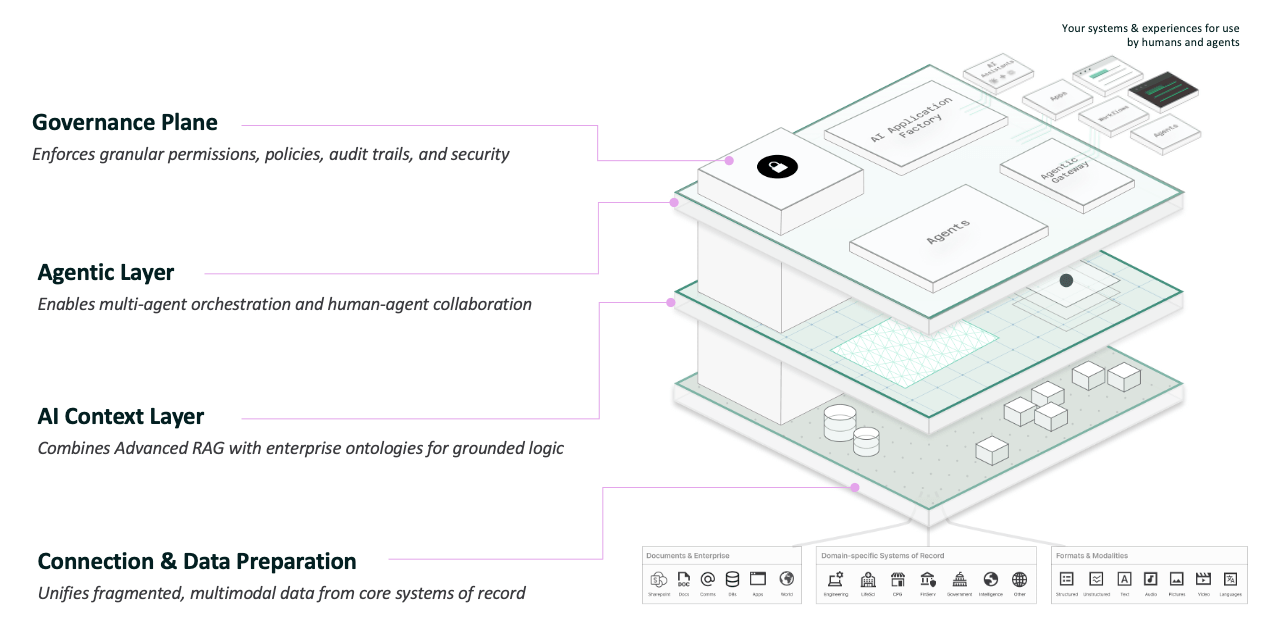
- Deep Connection & Data Preparation: Ingestion and secure indexing across fragmented systems of record, handling complex multimodal formats (from technical drawings to structured databases).
- The AI Context Layer: Bringing together Advanced RAG and enterprise ontologies. This structures raw data into domain-specific relationships so that every output is traceable, cited, and defensible.
- The Agentic Surface: An operational layer where humans and autonomous AI agents collaborate directly on complex, multi-step workflows.
- End-to-End Governance: A single control plane that enforces role-based access, strict policy compliance, full auditability, and total strategic autonomy over your data and infrastructure.
The Maturity Path: Building Toward Strategic AI Autonomy
Transitioning to Operational AI is a deliberate evolution. Organizations that succeed don’t attempt autonomous automation on day one; they establish a foundation of trust first.
- Stage 1: Enterprise-Wide Search Foundation — Break down data silos by creating a secure, unified query layer across all enterprise systems.
- Stage 2: AI-Assisted Humans — Empower experts with context-aware AI assistants that deliver cited, verifiable answers for complex decision support.
- Stage 3: Autonomous Agents — Deploy governed AI fleets that automate end-to-end operational tasks with complete auditability.
The quality of your context layer dictates the ceiling of your AI’s autonomy. When trust is engineered into every layer of the architecture, AI transitions from a simple productivity tool into a lasting competitive advantage
See Enterprise Agentic AI in action
Request a demoShare