












 Assistant
Digital Transformation Guide
Table of contents.
Navigate guide
Let’s start with a question: What is digital transformation? The business world loves its corporate speak. Jargon like grabbing the “low hanging fruit” and taking advantage of “synergies” is constantly used, yet many who say the phrases don’t even know what they mean. “Digital transformation” is another one of those buzzwords. It sounds impressive, but also nebulous. What is being transformed? How is digital transforming it? And why is everyone talking about it these days?
We’ll answer the last question first. As with many things in recent years, major business disruptions have forced or sped up radical business changes. A Gartner survey showed that 69% of boards of directors accelerated their digital business initiatives, with almost half anticipating changing their business model. As the world becomes increasingly digital, so too must the organizations that want to stay relevant and competitive.
But getting it right takes more than just digitizing a few things. It requires a reevaluation of, well, everything. What you do, how you do it, why you do it—these all need to be looked at with fresh eyes and a digital lens. And that’s where the concept of digital transformation comes in. This guide will answer some of the most common questions about digital transformation to provide clarity to what is a broad and complex concept.
What is Digital Transformation?
Digital transformation is the usage of digital technologies in all aspects of an organization to improve and/or fundamentally change how it operates both internally and externally. The goal of digital transformation is to reimagine how business gets done by finding ways to work smarter, faster, and more efficiently—or by discovering completely new ways to better compete. This could mean retooling internal processes to improve productivity or identifying a completely new business model or market to enter.
The Role of AI and Agentic Technology in Modern DX
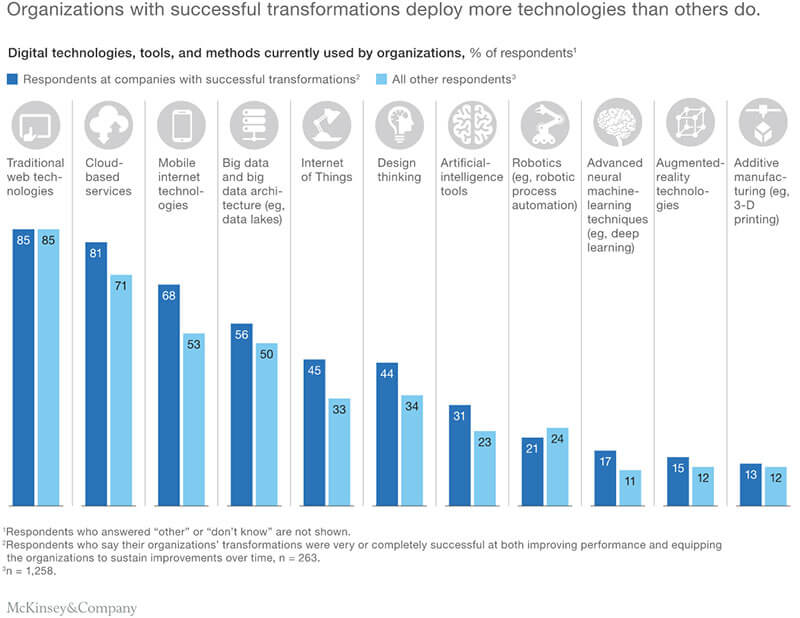
Modern digital transformation increasingly depends on AI and agentic systems. McKinsey research shows that organizations with successful digital transformation initiatives implement AI-powered automation and intelligent decision-making systems.
Today’s DX isn’t just about digitizing workflows; it’s about making those workflows intelligent. This is where agentic AI comes in—autonomous systems that can retrieve knowledge, synthesize information, make decisions, and take actions on behalf of humans. Rather than humans manually searching through enterprise systems, AI agents access federated knowledge sources, understand intent, and deliver actionable insights.
See our blog post: How a Digital Workforce Accelerates Your Digital Transformation
Why is Digital Transformation a top-of-mind strategy?
The obvious case for digital transformation is that technology and its adoptees (basically, all of us) demand it. Whether it’s an employee expecting a seamless remote work environment, or a customer expecting a quick problem resolution, there is a strong desire for companies to keep pace with the latest advancements.
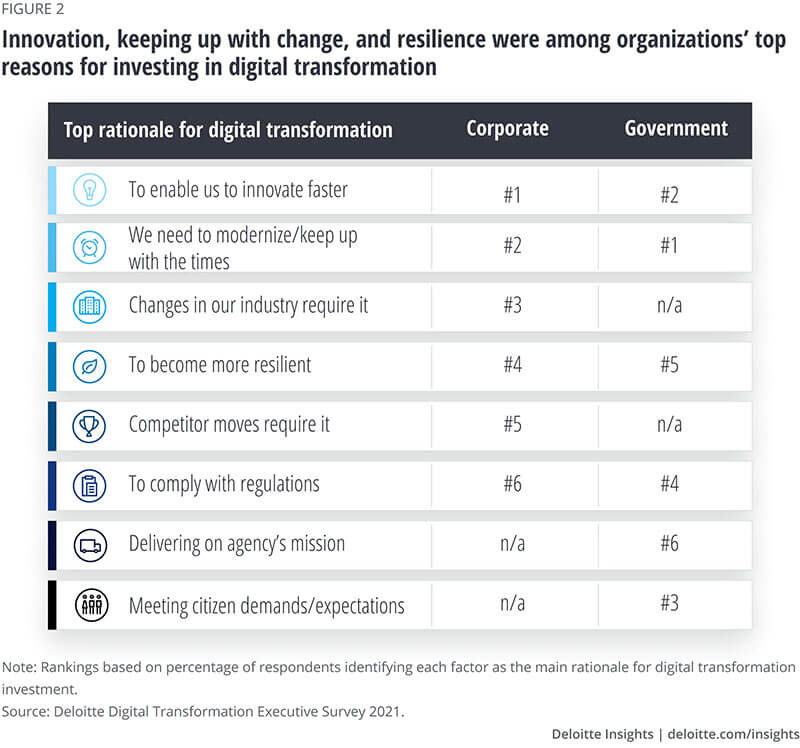
There are other reasons for digital transformation beyond meeting expectations. Deloitte’s “Digital Transformation Executive Survey 2021” showed that faster innovation, industry changes, and a need to be more resilient were all top rationales for digital transformation.
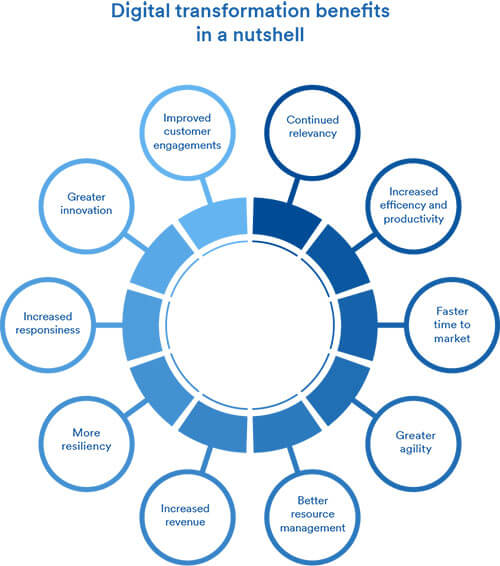
The Benefits of Digital Transformation
Operational Excellence
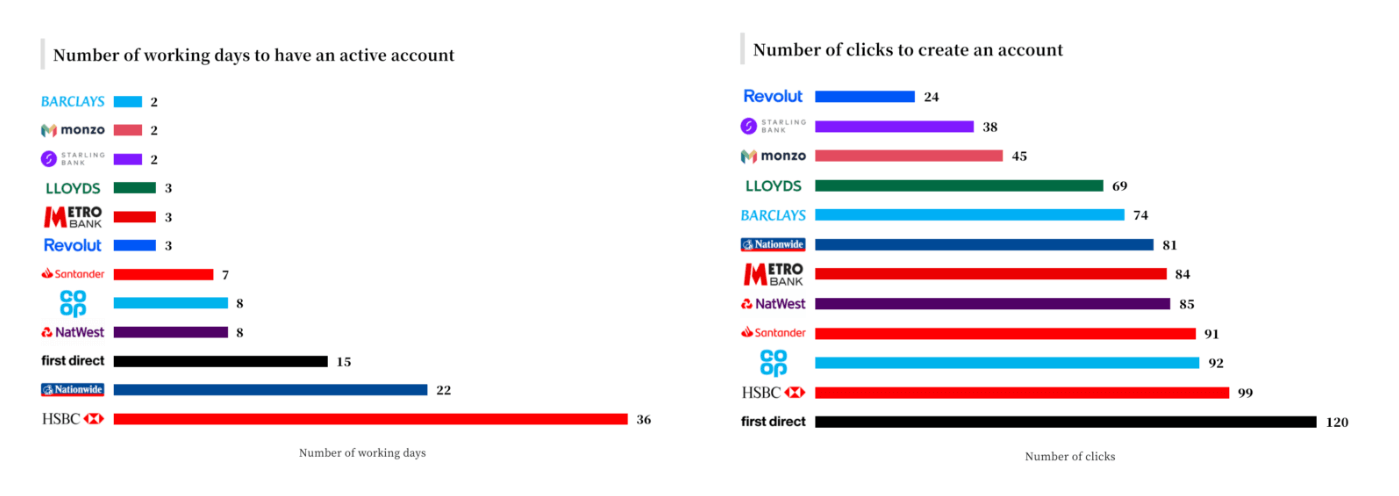
Digital transformation can greatly improve processes and products. An interesting example is the banking industry. Analysis shows how digitally savvy banks slashed the number of clicks and the number of days it takes to open an account, disrupting the market with a much-improved customer experience.
For enterprises embracing enterprise AI search and advanced RAG as part of their DX strategy, the benefits multiply. Instead of employees manually navigating multiple systems, intelligent search surfaces relevant information in seconds. This frees teams to focus on strategic work rather than knowledge hunting.
Knowledge Access and Data Findability
One critical challenge in digital transformation is making organizational knowledge accessible. Between 60% to 73% of corporate content is never analyzed for insights, representing a $3.3T opportunity cost globally.
Modern DX initiatives address this by implementing enterprise AI search and knowledge management systems that make findability a cornerstone. When employees can instantly find what they need, innovation accelerates and decision-making improves.
See our blog post: Why an Insight Engine Is the Secret Weapon of Your Digital Transformation
Customer Experience and Personalization
Salesforce research found that 59% of consumers use self-serve portals, 43% use chatbots for simple service, and 28% take advantage of automatic order replenishment—all outcomes of successful digital transformation.
Agentic systems take this further by personalizing interactions at scale, synthesizing customer data to deliver tailored experiences, and automating routine inquiries so humans can focus on complex issues.
See our blog post: Unlocking Customer Experience Excellence through Digital Transformation
Business Agility and Resilience
Digital transformation enables organizations to respond flexibly to customer needs and market changes. With AI-powered systems handling routine decisions and knowledge retrieval, teams can pivot quickly and focus on strategic innovation.
What is a Digital Transformation Framework?
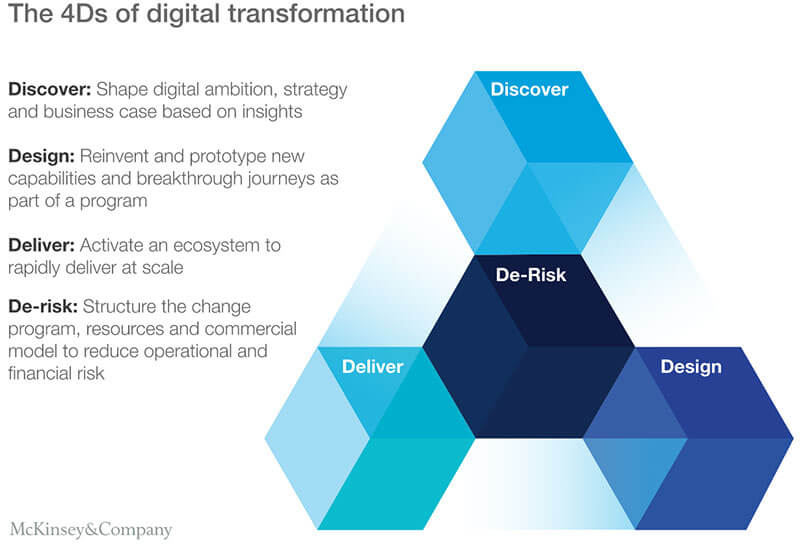
A digital transformation framework is a guide for how an organization can navigate major change. It serves as a common point of reference for all stakeholders, with a big-picture overview of what is to be accomplished and an “order of events” that can help the company get there. DX frameworks should be built to be adaptable for each unique business, but with clear steps that can be “checked off” as the organization moves through the process.
Because digital transformation is such a large and complex undertaking, a framework is necessary to keep everyone focused and working toward the same goals. The benefits of a DX framework are:
- It’s an agreed-upon process that all in the organization can refer to
- It details basic steps without being overly prescriptive—this gives organizations the room to make changes based on their unique needs
- It provides transparency into the transformation journey, helping executives, managers, and employees understand where the organization is in the process
- It enables accountability by establishing clear milestones and checkpoints
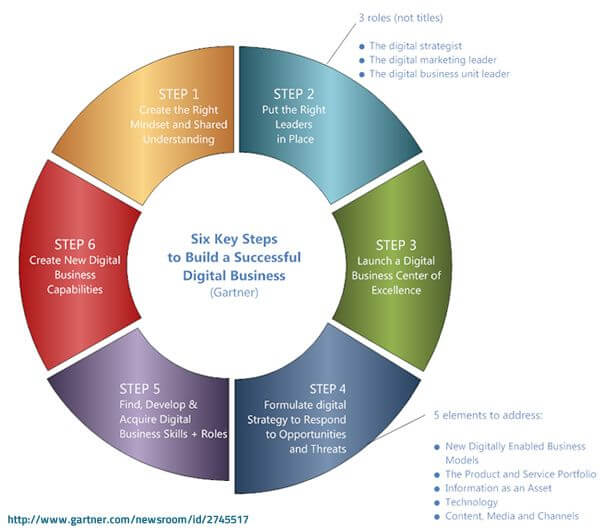
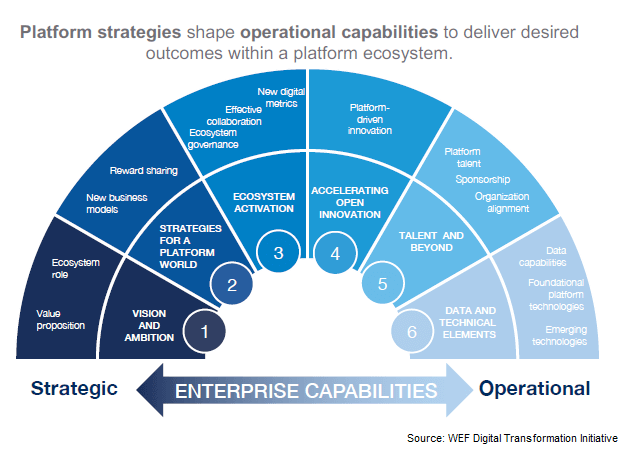
Digital transformation strategy
Like any business strategy, a digital transformation strategy starts with a situation analysis to arrive at the “why” of the transformation, then outlines specific objectives you want to achieve, steps to take to achieve those objectives, and metrics to gauge performance. It should answer these questions: Why do we need to transform? What do we need to transform? How can we transform?
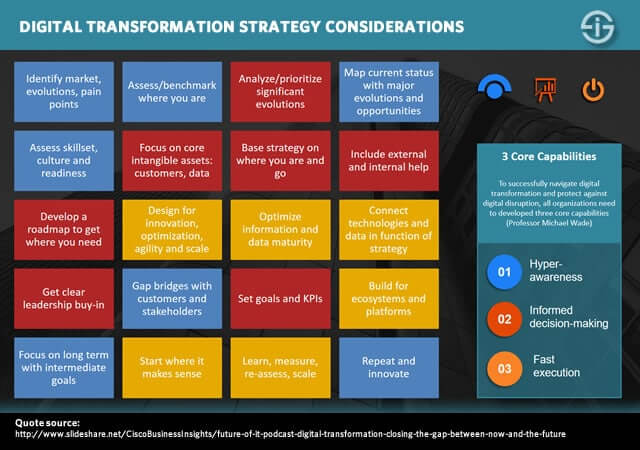
There are many considerations when building a DX strategy, including those outlined below:
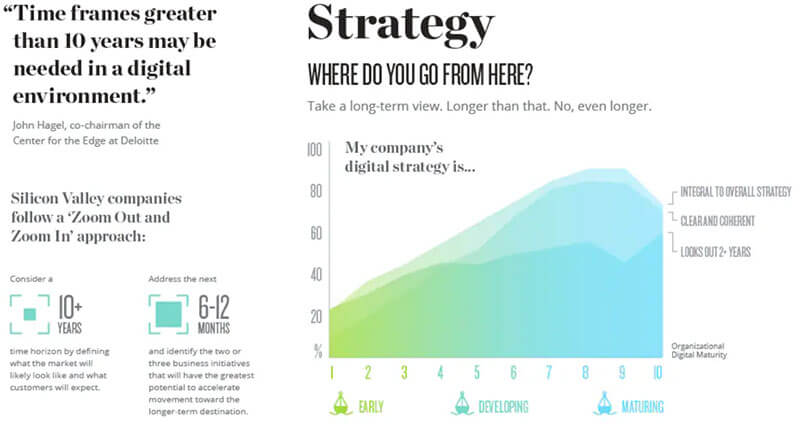
Be prepared to take a long-term approach to your digital transformation strategy. Many organizations have strategies that look up to 10 years ahead. At the same time, identify smaller initiatives that can be accomplished within a year or less that will contribute to the larger, longer-term goal.
What are some key trends in digital transformation
Digital transformation is subject to the technologies and trends of the moment. Here are some of the key trends driving DX efforts today:
- Data analytics and activation. According to a NetSolutions survey of more than a hundred senior executives from the IT, healthcare, media, and manufacturing industry, more than 50% say that being able to activate data is a key driver of digital transformation success. And 87% of CXOs surveyed by IDC say that developing a more intelligent enterprise is their #1 priority for the next five years. According to IDC, CXOs want to improve data decision-making by:
- Spending 80 percent of the time on analytics, and just 20 percent on data preparation. (Today, the reverse is true for most organizations.)
- Evaluating data needs during the problem definition phase of initiatives (including its extent, condition, and reliability).
- Practicing data-driven decision making and eliminating human bias. (That’s especially important as organizations increase their use of artificial intelligence (AI) and machine learning (ML)).
- Ensuring that teams and businesses make data-driven decisions rather than defaulting to experience or instinct.
- Hybrid cloud infrastructure. The 2020 pandemic accelerated the transition to the cloud for many as a way to stay agile and adaptable. Hybrid cloud infrastructure enables private clouds, public clouds, and on-premises data centers to communicate with each other through a single software platform. With this arrangement, companies have more control of their private data and therefore are exposed to less risk. At the same time, they can take advantage of the public cloud when more power and capacity is needed.
- Work from home. As a result of the pandemic, remote work became the norm and many companies are embracing it as a new way forward. Digital transformation efforts will continue around improving that experience, from new WFH devices to new ways to securely connect.
- Cybersecurity. Because more employees will be working remotely, cybersecurity continues to be a major concern. A Risk Based Security report found that 2020 was the ‘worst year on record’ in terms of the number of records exposed by data breaches. According to IBM’s “Cost of a Data Breach Report 2021”, in breaches where remote work was a factor, the average cost was more than $1 million higher than those where remote work was not a factor. Digital transformation strategies will focus heavily on upgrading cybersecurity to protect home networks and mobile WFH devices.
How to measure digital transformation
Digital transformation efforts are complex, cross-functional, and ongoing, which can make them tricky to measure. The key is to take a holistic view of all projects within the digital transformation umbrella. This ensures that quick win/small payoff projects and longer play/larger payoff projects are all equally accounted for.
There are a variety of metrics that can be used to measure success. Some considerations include:
- Direct business impact metrics, such as revenue growth, reduction in customer churn, new customer acquisition, time to market, or cost savings
- Operational impact metrics, such as productivity levels, hours saved, and employee satisfaction
- Scope of transformation metrics, such as the percent of processes designed for the cloud, the percent powered by AI, or the proportion of workflow that is automated
- Adoption and usage metrics, both for internal and for customer-facing technologies. These can include things like daily active users, abandon rates, and new vs. returning users
- Availability and reliability metrics, such as uptime, mean time to failure, and mean time to resolve
- Customer experience metrics, such as customer satisfaction (CSAT), sentiment analysis, or customer loyalty
- Sustainability metrics, such as energy savings, and emissions reduction
Impact on customer experience
One of the main outcomes of digital transformation is its positive impact on customer experience. This can take many shapes, like an omnichannel retailer connecting their online and in-store experiences, or a company adding new services or features that customers directly interact with, as well as the behind-the-scenes, back-office improvements that result in a better experience.
DX efforts can break down silos between teams to enable better communication, eliminate redundant work, and improve measurement. This can lead to a deeper understanding of needs and faster, better innovation.
DX can also break down data silos—key to understanding customer journeys, identifying pain points and achieving a 360-degree view of each customer.
Various departments of a business collect and store their own customer data sets. Sales has the account data. Marketing keeps track of customer interactions with marketing campaigns. Operations has customer order information. The warehouse has logistics information by customer. Accounting has customer billing and payment records. Legal has contracts, and so forth. In systemic terms, customer data can exist in warehouse operations management systems, sales operations software, email systems, document repositories, accounting apps and more.
Each department and its respective system represent a data silo. In many organizations, these silos act as impermeable boundaries to data access.
The figure below offers a visual representation of the data silo issue. While some businesses might consider data in the Customer Relationship Management (CRM) system to be a 360-degree view of the customer, it is really only a fraction of the total. In reality, customer data sits in multiple places inside an organization.
A DX strategy that includes enterprise search can cut across organizational silos. Equipped with an enterprise search solution, a customer service representative (CSR) can now look up a customer’s complete data set in real time.
This way, if a customer calls with an issue, the CSR can immediately see any and all relevant issues that might affect the customer’s experience and relationship with the business. The search interface can show the CSR the customer’s complete record, including pending sales opportunities, accounts receivable balances, service issues, legal contract terms and other pertinent information.
As we’ve pointed out at the beginning of this guide, digital transformation can also greatly improve processes and products. An interesting example is the banking industry. This analysis from Smart Insights shows how digitally savvy banks slashed the number of clicks and the number of days it takes to open an account, disrupting the market with a much-improved customer experience.
How to drive digital transformation success
What’s the key to hitting your digital transformation efforts out of the park? There are several answers to that question, but one of the most important solutions is to get buy-in–not just from the top but from each and every employee. This is why hiring the right talent and effective change management factor heavily in most digital transformation frameworks.
McKinsey’s research into this topic over the years has shown that for organizations with successful DX efforts, they all follow best practices in five categories:
- Leadership
- Capability building
- Empowering workers
- Upgrading tools
- Communication
The Harvard Business Review’s “Digital transformation is not about technology” article supports this finding, stating, “…most digital technologies provide possibilities for efficiency gains and customer intimacy. But if people lack the right mindset to change and the current organizational practices are flawed, DT will simply magnify those flaws”.
The survey findings below from McKinsey show that when management “established a clear story for change transformation”, respondents were 3.1 times more likely to say that their digital transformations were successful.
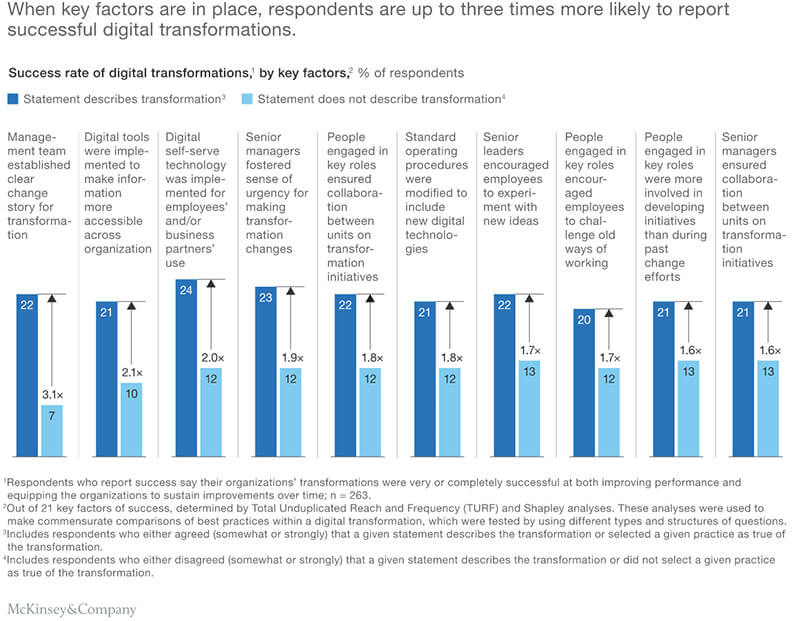
The same survey from McKinsey also found that those that hired a Chief Digital Officer (CDO), were 1.6 times more likely to report a successful digital transformation, yet less than a third have done so. Getting the right leaders in place with digital backgrounds can streamline and speed up DX efforts, and perhaps be the difference between success and failure.
The role of corporate culture in digital transformation
Fostering an open and collaborative culture is also key to smooth DX. Change shouldn’t be mandated by the management team but contributed to by employees at all levels.
Use their feedback to inform your strategy. Make them feel welcome to be bold and share new ideas and provide their opinions on what is and isn’t working as the transformation rolls out. Delegate and give them the freedom to make some decisions in the process. Encourage collaboration.
All of this builds a culture where everyone feels valued and connected to the organization’s shared vision, and in this case, the reasons for digital transformation.
In fact, a BCG study of 40 digital transformations found that those that focused on culture achieved breakthrough performance five times more often than those that didn’t prioritize culture.
Key Success Factors for Digital Transformation
Getting Buy-In at Every Level
What’s the key to hitting your digital transformation efforts out of the park? One of the most important solutions is to get buy-in—not just from the top but from every employee. Hiring the right talent and effective change management factor heavily in most digital transformation frameworks.
McKinsey’s research into this topic over the years has shown that for organizations with successful DX efforts, they all follow best practices in five categories: clear change leadership, technology foundation, talent and skills, culture and organization, and process and governance.
Leveraging Intelligent Systems and AI
Modern DX requires more than implementing technology—it requires making that technology intelligent and agentic. This means:
- Enterprise AI Search: Unified search across all knowledge sources (documents, databases, emails, collaboration tools) powered by natural language processing and semantic understanding
- Advanced RAG: Retrieval-Augmented Generation enables AI systems to synthesize answers from multiple sources and cite their sources reliably
- Agentic Automation: AI agents that can independently retrieve knowledge, understand context, make decisions, and execute actions
- Role-Based Governance: Early-binding security ensures employees and agents only access information they’re authorized to see
See our blog post:Why Knowledge Management Strategies Need AI-Powered Search
Manufacturing and Industry 4.0
Digital transformation in manufacturing represents a specific challenge. Industry 4.0 initiatives rely on intelligent search to optimize manufacturing operations, combining AI, machine learning, big data analytics, and enterprise search to create a digital thread across design, R&D, engineering, production, and service.
See our blog post:IDC Research Technology Spotlight: Digital Transformation of Manufacturing
Digital transformation tools
No digital transformation is complete, of course, without the right digital tools in place. What those tools are will vary greatly depending on needs, level of maturity, and the industry and market factors of your organization.
There are, however, some common categories that appear often in DX plans:
- Cloud solutions, like Microsoft Azure or Amazon Web Services
- Collaboration tools, like Slack
- CRM tools, like Salesforce or SAP
- Data management tools, like Apache Hadoop
- Enterprise search tools, like Sinequa
- Digital accounting tools, like Sage
- Project management tools, like Wrike or Jira
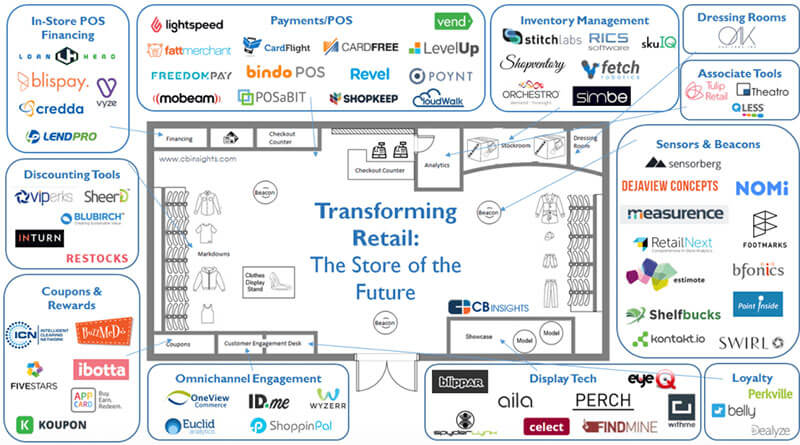
This is by no means a complete list. Nor does it take into account the unique needs of specific industries, which require digital tools above and beyond those listed above to make a complete digital transformation. For example, the image below gives a birds-eye view of the dozens of technologies that a retail store could potentially employ as part of its digital transformation, from inventory management tools to loyalty program tools and even dressing room technology:
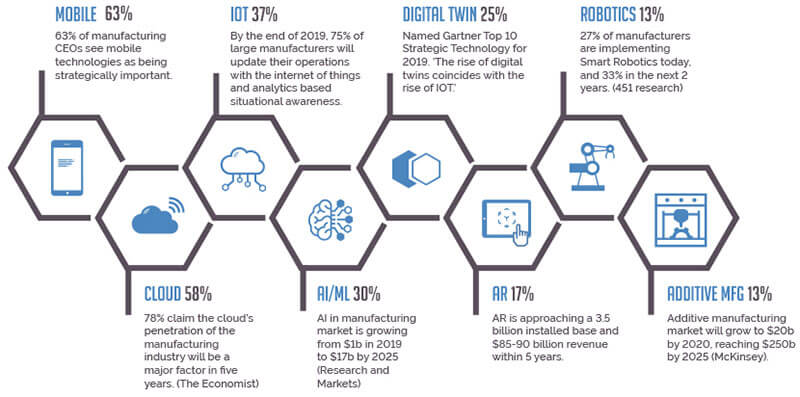
And this graphic shows the average current adoption rates of digital tools and technologies by industrial companies which include, among other things, augmented reality, robotics, and digital twins:
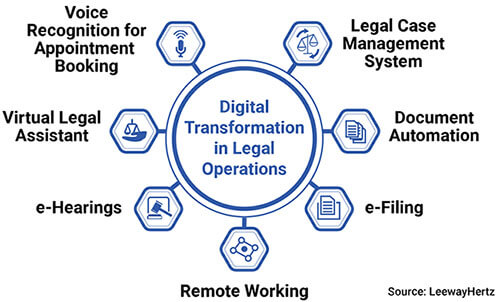
And finally, this example from the legal field, which shows the specific digital tools it requires to enable e-Hearings and virtual legal assistants:
It’s interesting to note that according to McKinsey, organizations that deploy more technologies and use more sophisticated technologies like artificial intelligence (AI), machine learning, and Internet of Things (IoT) were more likely to have successful transformations.
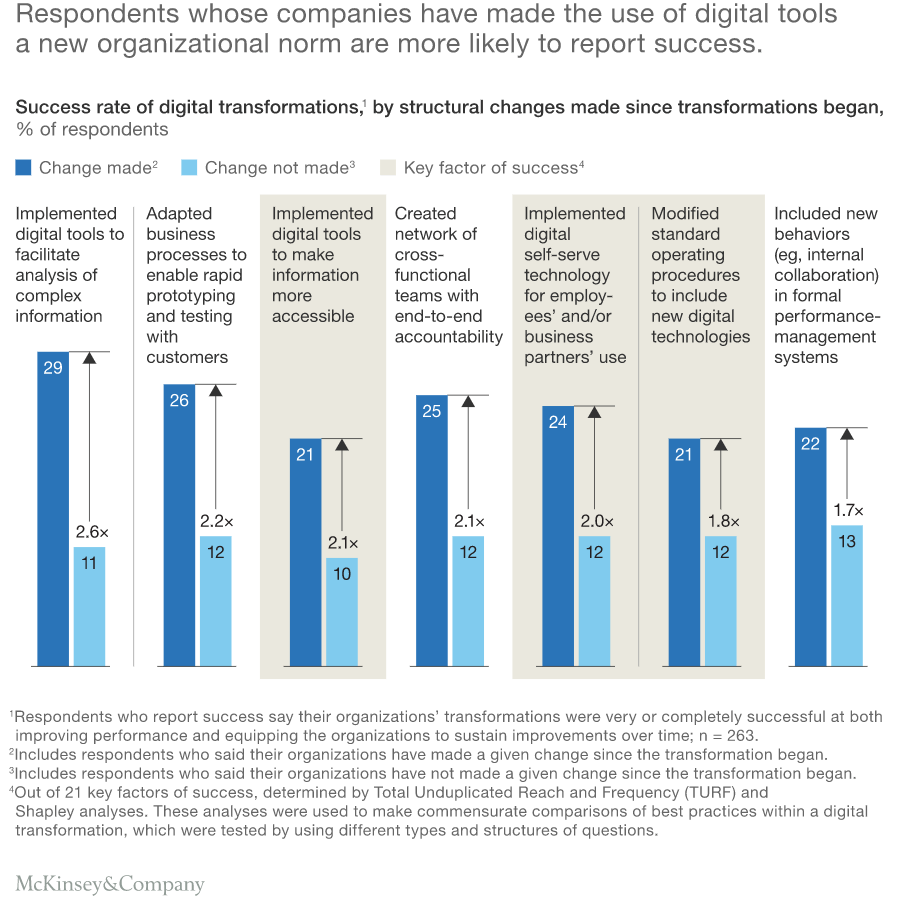
In addition, those that added digital tools to make information more accessible had a DX success rate that was two times higher and rated it as a key factor in the success of their transformation.
To make information more accessible, an enterprise search tool like Sinequa is needed. An enterprise search tool can access content in all formats across all sources, including both structured and unstructured data and regardless of type, location, or language. It then provides automation via natural language processing technologies to help interpret meaning from all of the various content ingested.
This serves as a foundation to provide relevant search results, analytics, and accurate robust machine learning. Machine learning then transforms the content and data into relevant information and actionable insights, continuously learning and improving as it takes in more data. This is all then presented to users in an easy-to-use interface.
Digital transformation use cases
DX efforts are happening all around the world, in companies large and small. Here are just a few examples of how companies are transforming how they do business with the power of digital:
Energy giant, General Electric, employed sensors, data networks, and analytics to their wind turbines to customize each for maximum efficiency. The efficiency improvements to the turbines translated to billions of dollars of value for GE.
A global pharmaceutical company focused on treating neurological and immunological diseases was frustrated by its inability to identify clinical trial risks slowing drug pipeline time-to-market. By implementing an enterprise search solution, the company was able to inform decisions, improve productivity and innovation that reduce risk, lower costs, and enable faster time-to-market of new drugs.
Fujifilm was a sinking ship in 2010 when it transformed its business model, pivoting from a photographic film manufacturer to a healthcare and technology company. They used their imaging roots to develop medical imaging equipment, digital x-ray diagnostics, and other medical technologies. By entering new markets, Fujifilm rescued itself from near extinction to become even stronger than before.
The Role of Data and Knowledge in Digital Transformation
A cornerstone of successful digital transformation is making data and knowledge accessible and actionable.
The Scale of the Challenge
The amount of data being generated is staggering. The amount of data generated, gathered, copied, and consumed is projected to reach zettabytes by 2025. In a world drowning in data, knowledge you can’t find isn’t power—it’s a problem.
Enterprise Search as DX Infrastructure
When implementing digital transformation, many organizations focus on new tools and technologies. But without making existing knowledge discoverable and accessible, DX efforts stall. This is why enterprise search—especially intelligent, AI-powered search—is foundational infrastructure for modern DX.
Intelligent search enables:
- 360-degree customer views by integrating data from multiple sources (CRM, web interactions, transactions, social posts)
- Regulatory compliance through automated data classification and governance (GDPR, HIPAA, etc.)
- Decision acceleration by surfacing relevant context in real-time
- Employee productivity by eliminating hours spent searching for information
Intelligent Systems and The Future of Digital Transformation
The future of digital transformation is intelligent. Organizations that invest in AI-powered enterprise search, advanced RAG, and agentic systems today will have a significant competitive advantage tomorrow. Consulting firms like Deloitte emphasize that successful digital transformation requires integrating AI-powered intelligence into knowledge management and decision-making processes.
This means:
- Natural Language Processing (NLP): Employees can search using everyday language, not complex syntax
- Machine Learning: Systems learn from past interactions to improve relevance and recommendations
- Agentic Decision-Making: AI agents make routine decisions autonomously, freeing humans for strategic work
- Continuous Learning: Feedback loops enable systems to improve over time
See our blog post:The Transformative Influence of AI and Machine Learning on Digital Advancements
Digital Transformation Implementation Roadmap
A successful digital transformation follows these key phases:
Phase 1: Assessment and Strategy
- Audit current state of technology, processes, and data
- Define clear DX goals aligned to business outcomes
- Identify quick wins and longer-term initiatives
Phase 2: Foundation Building
- Implement or upgrade core infrastructure (cloud, databases, data integration)
- Establish data governance and security frameworks
- Deploy enterprise search and knowledge management systems
Phase 3: Intelligent Automation
- Implement AI-powered systems (enterprise search, advanced RAG)
- Develop agentic workflows for routine decisions
- Establish role-based access control and compliance monitoring
Phase 4: Continuous Optimization
- Monitor KPIs (decision velocity, employee productivity, customer satisfaction)
- Gather feedback from users and agents
- Iterate and improve based on real-world performance
Share


