Book a Demo

See Sinequa Live. No commitment. Tailored to your use cases.


Comparative Analysis · Enterprise AI Search · 2026


Enterprise AI Search in 2026: Sinequa vs. Glean vs. Coveo vs. Elastic


Not All Enterprise Search Platforms Are Built for the Same Problem.


Finding the right information at the right moment — across millions of documents, emails, tickets, and reports spread across dozens of systems — is one of the most persistent challenges in the modern enterprise.

Sinequa, Glean, Coveo, and Elastic come up repeatedly in enterprise RFPs and analyst evaluations. But they serve very different needs and very different organizational profiles.

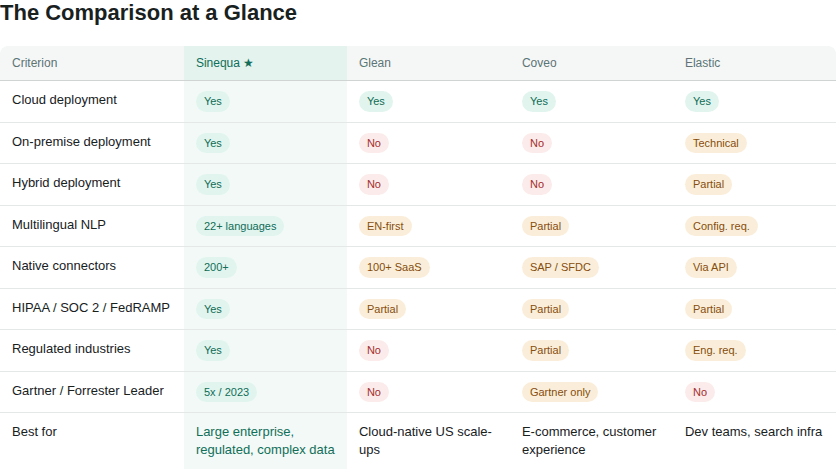
This page compares them on the six criteria that actually drive shortlisting decisions in large organizations. Curious to see if Sinequa is the best fit for your environment? The form on the right is the fastest way to see it live.

Enterprise AI Search Vendor Evaluation

The Six Criteria That Actually Drive Enterprise Search Decisions

In practice, six dimensions drive the majority of shortlisting conversations in large organizations. Vendor demos and feature lists rarely surface the differences that matter. These criteria do.

The Four Platforms — What Each One Actually Is

Originally founded in France in 2002, Sinequa is now part of ChapsVision and operates globally with offices in New York, London, and Paris. The platform is built for large, complex organizations and has been recognized five consecutive times as a Leader in the Gartner Magic Quadrant for Insight Engines, and as a Leader in the Forrester Wave: Cognitive Search (Q4 2023). Its US customer base includes global organizations in life sciences, financial services, energy, manufacturing, and government, including Pfizer, AstraZeneca, and NASA.

Unlike most competitors, Sinequa supports cloud, on-premise, and hybrid deployment natively. It indexes over 200 connector types covering 350 document formats, including non-SaaS sources such as SAP, mainframes, and proprietary document management systems that are common in large industrial and regulated organizations.

  • 200+ native connectors, 350 document formats
  • Advanced NLP in 22+ languages (entity extraction, semantic disambiguation, cross-language retrieval)
  • Cloud, on-premise, or hybrid deployment
  • HIPAA, SOC 2, GDPR certified with document-level access controls
  • Neural Search + RAG architecture, natively integrated
  • 5x Gartner Magic Quadrant Leader / Forrester Wave Cognitive Search Leader Q4 2023

Founded in 2019 in Palo Alto, Glean is the fastest-growing player in the US enterprise search market. Its “Work AI” platform combines search, an AI assistant, and agentic AI workflows on a single interface, and has resonated strongly with cloud-native organizations. The numbers are hard to ignore: $200M ARR as of December 2025, doubling in nine months, and a $7.2B valuation after its Series F round. Glean has 100+ SaaS connectors and is deeply integrated with the modern cloud-native stack: Slack, Google Workspace, Notion, Confluence, Salesforce, Jira.

Glean is cloud-only and primarily targets US-based organizations. Its NLP is optimized for English. For organizations in regulated industries requiring HIPAA-compliant on-premise or private cloud deployments, or for global enterprises with significant non-English content, it presents real limitations.

  • ARR: $200M (December 2025, source: Fortune)
  • Valuation: $7.2B (Series F, 2025)
  • 100+ SaaS connectors
  • Cloud deployment only
  • NLP primarily optimized for English
  • No on-premise or regulated industry deployment options

Founded in Montreal in 2005 and publicly traded on the Toronto Stock Exchange (TSX: CVO), Coveo is built around AI-driven relevance for digital experiences. Its strengths are in e-commerce search personalization and digital customer service, not primarily in internal workplace search for employees. Its FY2025 revenue reached $133.3M, with 700+ enterprise customers and a strategic partnership with SAP that drives 50% of its new Commerce clients. Like Glean, Coveo is cloud-only.

  • FY2025 revenue: $133.3M (source: ir.coveo.com)
  • 700+ enterprise customers
  • SAP strategic partnership
  • Cloud deployment only
  • Strongest in e-commerce search and digital customer experience
  • Gartner Leader in its category

The creator of Elasticsearch, Elastic (NYSE: ESTC) is the backbone of search infrastructure for a large share of the technology industry. With FY2025 revenues exceeding $1.4B and approximately 21,500 subscribers, it operates at a different scale than the other platforms here. Elastic is developer-oriented by design: it provides a powerful, flexible foundation for building search applications, but requires significant engineering investment to configure, operate, and integrate. It dominates enterprise search SERP rankings largely due to domain authority, but it is not positioned as a turnkey workplace search solution.

  • FY2025 revenues: $1.4B (source: BusinessWire)
  • ~21,500 subscribers
  • Cloud or on-premise, requires engineering resources
  • Developer and infrastructure-oriented, not turnkey
  • Strong for RAG architectures with technical teams
  • Not a Gartner Leader in the enterprise search / insight engines category
Generative AI that knows your business

Where the Differences Matter

Vendor demos and feature lists rarely surface what actually separates these platforms. Here is where the evaluation gets real.

For a US cloud-native tech company with no regulatory constraints, cloud-only deployment is a non-issue. But for a pharmaceutical company subject to FDA data governance requirements, a federal agency with FedRAMP mandates, or a financial institution with strict data residency rules — it can make an entire platform ineligible before feature evaluation begins.

Glean and Coveo are cloud-only, full stop. Elastic can be deployed on-premise, but the engineering overhead is significant. Sinequa natively supports all three models: public cloud, hybrid, and fully on-premise. This is what allowed Sinequa to be deployed within government agencies and heavily regulated environments where no third-party cloud data storage is permitted.

In regulated US industries, the compliance conversation starts with HIPAA for healthcare and life sciences, SOC 2 Type II for general enterprise security, and FedRAMP for government-adjacent workloads. Document-level access control — where search results respect the permissions defined in source systems at query time — is equally non-negotiable in environments with strict information governance.

Sinequa holds HIPAA, SOC 2, and GDPR certifications and enforces document-level access controls natively. This is precisely what made it the platform of choice for Pfizer and AstraZeneca, where research documents, clinical trial data, and proprietary formulations must remain accessible only to authorized users.

Glean is optimized for English. For a US company with operations primarily in North America, that is adequate. For a US-based multinational with research teams in Germany, manufacturing sites in Japan, and sales organizations across Latin America — it is a material limitation.

Sinequa processes 22+ languages with advanced NLP, including entity extraction, semantic disambiguation, and cross-language retrieval — built and refined over more than two decades on complex enterprise environments. A query submitted in English surfaces relevant documents in French, German, or Spanish without manual configuration per language.

Glean’s 100+ SaaS connectors cover the modern cloud stack extremely well. For a software company or digital-native enterprise, that is most of what matters. For a pharmaceutical company running SAP, a manufacturer with proprietary engineering document management systems, or a financial institution with legacy mainframe infrastructure alongside modern cloud tools — the picture is very different.

Sinequa’s 200+ connectors include sources that Glean simply does not reach: SAP, mainframes, proprietary content management platforms, and legacy database systems that remain core infrastructure in industrial and regulated enterprises.

Sinequa has been a Gartner Magic Quadrant Leader for Insight Engines five consecutive times and earned Leader status in the Forrester Wave: Cognitive Search (Q4 2023). Coveo holds a Gartner Leader position in its category. Glean does not have equivalent analyst credentials in the enterprise search space. Elastic is not positioned in this specific Gartner or Forrester evaluation.

Which Platform Fits Which Organization?

There is no universal answer. The right platform depends on your IT environment, regulatory constraints, industry, and organizational profile.

For large enterprises in regulated industries specifically, Sinequa is consistently the more complete answer. The 30% reduction in engineering search time measured at Siemens, the deployment of 12 distinct search applications at Alstom, and the long-running deployments at organizations like Pfizer, AstraZeneca, and NASA illustrate what the platform delivers in environments where both the data complexity and the compliance requirements are real.

🏛️
Sinequa – Large US and global enterprises in regulated industries (life sciences, financial services, energy, manufacturing, government) with heterogeneous IT environments requiring on-premise flexibility, multilingual NLP, and deep connector coverage.
🚀
Glean – Cloud-native US organizations with a modern SaaS stack, primarily English-language content, and no significant on-premise or data residency requirements.
⚙️
Coveo – Enterprises prioritizing digital customer experience: e-commerce search personalization, self-service support portals, and product documentation.
📊
Elastic – Engineering teams that need a flexible search infrastructure layer and have the technical resources to build, configure, and maintain it.
Cummins Pfizer logo NASA logo logo Exxon Mobil TotalEnergies logo Societe Generale logo BASF_ Takeda logo Navy Federal Credit Union Logo Capgemini Logo Ciena Akamai logo Airbus logo

Sinequa is our intelligent knowledge platform—the enterprise brain that finally connects our tools, data, and people.

Oliver Scott Beard Engineering Efficiency Project Manager at Cummins

We lose a lot of time searching through our various databases and existing tools, along with drawings and technical documentation. We selected Sinequa’s search engine because of its high performance and the fact that it’s straightforward to index databases.

Frédéric Antoine, Technical Support Network Manager, Airbus Helicopters

With Sinequa, we are building powerful next-generation search that is simple and intuitive enough for our R&D scientists to use easily and be alerted
to new information anywhere, anytime.

Nick Brown, Technology Incubation Director, Astrazeneca

If Siemens only knew what Siemens knows; that was the initial challenge... now our employees find insight more efficiently - we're 30% faster with Sinequa.

Dr. Thomas Lackner, CTO Office, Corporate Technology, Siemens

Sinequa’s Intelligent Search platform’s in-depth analysis provides Alstom’s employees with a thorough understanding of unstructured data, including the text coming from very complex technical and normative documents. This allows greater efficiency and real time savings for Alstom’s data scientists.

Tristan Le Masne, Vice President Internal Audit & Internal Control, Alstom

See How Sinequa Performs in Your Environment.

200+ connectors. 22+ languages. On-premise, hybrid, or cloud. HIPAA certified. 5x Gartner Leader.

Book a Demo